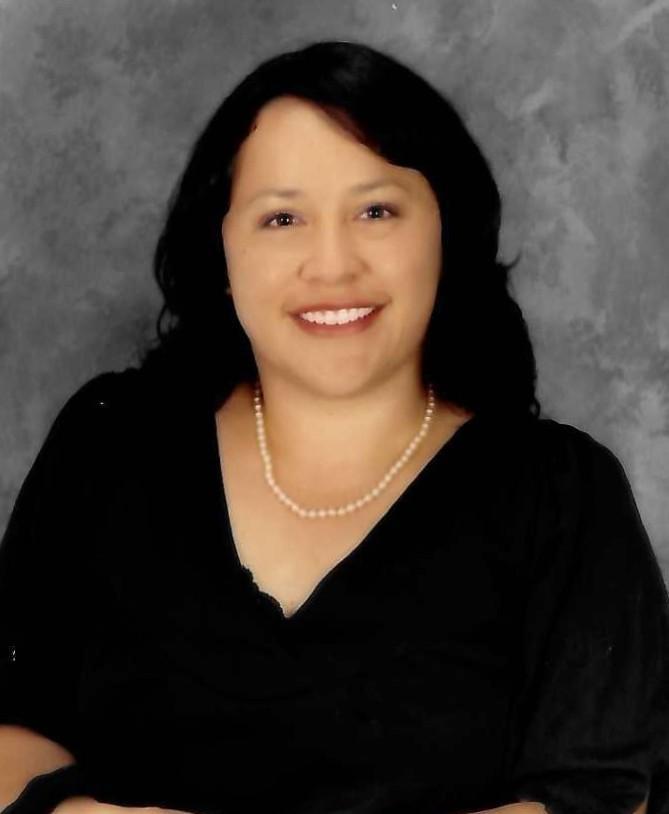
Born in San Francisco, California, Angelina Santana recalls a much gentler time for immigrant families. Today, as assistant principal at Eastlake High School in Chula Vista, California, AFSA Local 150, Angie is devoted to helping her students find the opportunities and resources they need for success, regardless of their families’ status.
Years ago, when her parents and older brother were sent back to Mexico, extended family on this side of the border made an all-out effort to bring them back to the United States in time for Angie’s birth. Raised in San Francisco, she quickly learned the importance of mentoring in her own life and has been committed to mentoring others ever since.
The women in her life—her aunts in Mexico and her “spiritual godmother,” Consuelo Lopez—were “the childhood mentors who left an imprint.”
Another mentor, teacher Alec Lee, helped start and lead the Aim High summer program for lower-income students at Lick-Wilmerding Middle School, one of the affluent schools in San Francisco. “The program helped kids like my older brother and me avoid the gang violence between Sunnydale and Hunter’s Point.”
Attending Aim High inspired her to consider going to high school there, even though she initially wanted to stay with her friends in Visitation Valley. In high school, she encountered two other major influences, Mrs. Eleanor McBride and Ms. Malia Dinell, both science teachers.
“Even though English wasn’t my first language,” she says, “I didn’t have to struggle much because they were so hands on. We were all learning new science words, and I eventually learned to love science.”
Thanks to Lee, McBride and Dinell, she went on to Santa Clara University, where she met Dr. Ramon Chacon, “a father figure on campus to all the Latino students, especially those of us with Mexican-born parents.”
In college, most biology majors were viewed as pre-med, so Angie saw herself that way, too. “But I discovered that I fainted at the sight of blood and even though everyone told me that it would pass, it didn’t.”
Having worked at Aim High as a teacher’s aide in science, Angie thought of teaching as a career alternative. Everything went according to plan. Along the way, she earned a Master of Arts in Secondary Education at San Francisco State University. When the time came to find work, she says, “There was a great need for science teachers and being a Spanish-speaking female Latina was the best case scenario.”
Parkway Heights Middle School in South San Francisco was her first home, and she loved it. “I fell in love with the kids’ energy. Many people have problems with middle schoolers, but I thought they were exciting.”
At Parkway Heights, she discovered a virtually abandoned lab, cleaned it out, and brought in supplies. The students loved it.
Her next adventure was at Menlo-Atherton High School. At that time, the Bay Area was a hub of biotechnology: “We were surrounded by companies like Genentech, that were focused on gene technology. Bringing this concept into the classroom, we did a lot of forensic work ourselves. The kids were excited to act as lab scientists, using DNA from a strand of hair to perform DNA fingerprinting, sparking their interest in forensic science careers.”
But the downside of being in the capital of the dot-com boom was getting priced out of housing. In 2002, she moved to the San Diego area for more reasonably priced accommodations and has been part of the Sweetwater District ever since, starting out as a biology teacher at Chula Vista High School.
As she went on to teach at other high schools, one of her principals, Earl Wiens, told her she could be an assistant principal. Having been a Teacher on Special Assignment (TOSA) in the district’s curriculum office, she saw the sense in this. She had helped five middle schools focus on the creation of professional learning communities, and mentoring staff came naturally.
When she started as an assistant principal at Chula Vista Middle School, she says, “The transition was a humungous change. The reality is that 80% of our job is dealing with issues. We were just putting out fires all the time.” She adds, “I’m usually a very happy-go-lucky. I had to bring that energy to bear and for the most part, I did.”
For years, she had considered pursuing her doctorate, as Dr. Chacon had recommended. “It was always in the back of my mind,” she recalls, “but as the only girl in a Mexican family, I was the go-to person; I was always needed.”
When her mother fell ill with cancer during the pandemic, she told Angie that “there’s never a good time.” That’s when she enrolled in the University of Massachusetts Global Program and afterwards never looked back.
Today, doctorate in hand, she looks ahead to paying it forward as a principal or a curriculum specialist in San Diego or San Francisco. She takes long walks and jogs and loses herself in salsa dancing to get away from obsessing about the future. Indeed, there is a great deal to contemplate in terms of a future as a principal or curriculum developer.
Given today’s immigration situation, she says she is grateful to her superintendent Dr. Moisés Aguirre for providing school leaders with tremendous guidance, and for his willingness to put himself on the front lines to “uphold our values of equity, safety, and respect for all regardless of immigration status.”
As Angie recalls her own family’s deportation stories, she says, “Today, if kids do not feel safe or are suffering from hunger, it’s hard to talk about curriculum. There is a lot for us to think about.”